
Now Boarding.
Lao Tzu famously penned, “the longest journey begins with a single step.” But what if your journey never started with a step? What if it rolled. Mazda has always had innovation, style, uniqueness, and most of all fun at rather core of every product it has created. Let’s put a pin in that for a second.
Humans by nature are nomads and have an unquenchable thirst for adventure and to go beyond where they are standing; The Vikings, Magellan, Lindberg, Earhart, Armstrong, the list goes on. It is in our basic building blocks to go out and discover new places and worlds. Times may have changed, as now everyone can discover new places in comfort, style, ease thanks to the vast infrastructure of the air travel and the internet. Explorers (you and me) no longer are bringing what they need to survive against natures worst elements, possible hostile environments and cultures along the way. Explorers now bring sheik luggage, outfits inside depending on their mood and discourse. Forget start-ups, bitcoin, apps, venture capitalists, the luggage industry is an overlooked and one that needs more respect in people’s conversations at the watering hole.


For most of us when we go to the airport or a trip for that matter we really do not think too much about the bag we are taking, we just hope that it fits all of our belongings and will be accepted so we can squeeze it into the overhead compartment without making a scene. And even though there is room underneath the seat in front of us, we all know that is reserved for our feet. That bag or suitcase you are carrying is part of a multi-billion dollar global market that is booming thanks to the increase in travel, rising incomes (disposable income), shifting consumer preferences toward style, functionality, and technology. The luggage global market was valued around $39 billion in 2023 and is expected to reach a staggering $60 billion in 2030, that is a $20 billion increase in seven years! That amount would have to be checked in, not carried on. This growth is due to demand in innovation with smart features like USB ports, GPS integration, smart locks, longer lasting, lighter, sustainable materials, better durability and of course just like in the car industry demand for utilitarian and luxury options, mainly customization, aesthetics, unique colors, and personalization is crucial to the the evolution of the luggage. From mere function to fashion to having a status symbol. Because you can’t just have your bag while going through the airport, you have to have people create a narrative for you as you walk by.

Ok, so that was a lot to unpack about a question you never asked or needed. Airports. What is not to love about them? From an engineering stand point they are modern marvels, large in size, but small micro cities that are housing millions of people daily. Getting them to and from all corners of the world, all while in a controlled environment. They are designed to have flow of traffic be as efficient as possible, have planes land and take-off with minimal delays while having the flyer surrounded by endless food, drink, entertainment, lounges, stores, gifts, with some airports offering you more than your local town. So what does this have to do with Mazda?

Singapore Airport
As any flyer knows sometimes getting to your terminals is a bit of a trek and unless you are Usane Bolt or have the ability or being escorted by one of the SkyCap golf carts, you are at risk of having a heart attack getting to get to your gate on time. Mazda came up with a solution to have you gracefully arrive at the gate in a calm, collective, relaxed state of mind with your hair looking great.
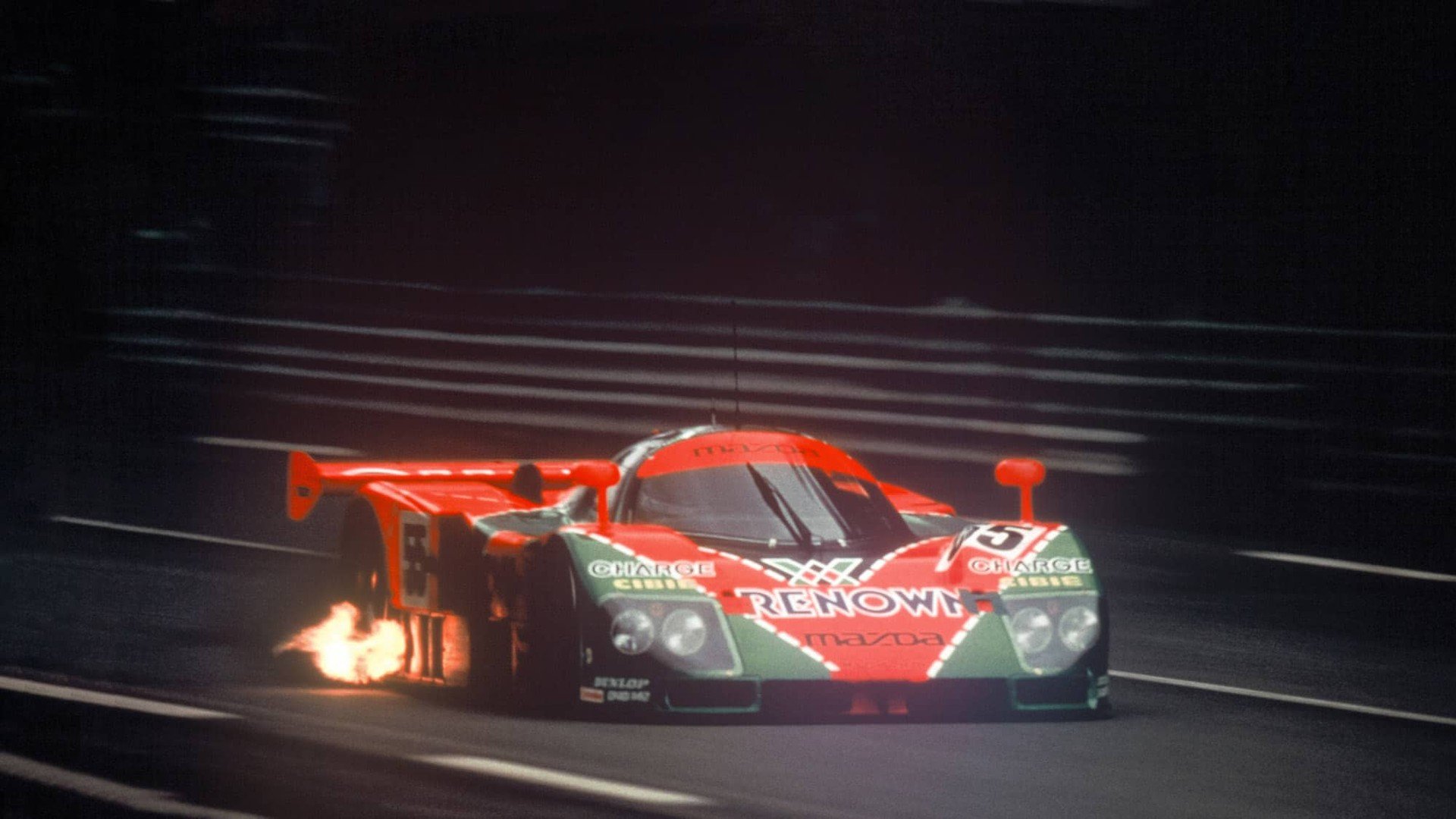
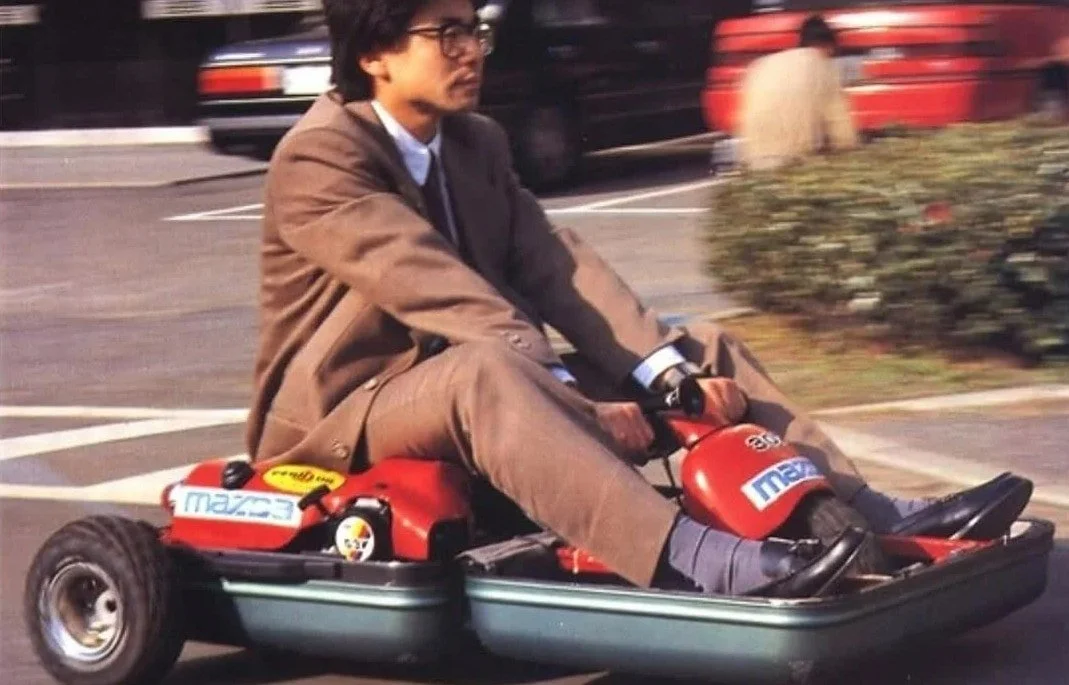
Mazda created the suitcase Car. Say what? This happened in the 90’s and you have to remember the 90’s were a crazy and pivotal time in history. Technology was starting to catch up to imagination, the internet was happening, optimism was in the air with the end of the Cold War, Home Alone, Goodfellas, and Terminator 2 were in the theaters, people were loving life. Mazda had also just released the Miata (later named the MX-5), the car that helped bring a much needed onslaught of attention of outside buyers to the company. On top of the Miata’s commercial success Mazda also just won the 24hrs of Le Mans with the legendary and masterful 787B Renown, the first Japanese company to do so and a first with a rotary engine.
Mazda was winning and it was oozing with confidence much like me at an open bar at a wedding. Headquarters in Hiroshima was feeling the same effects as well. But instead of false hope and going on the dance floor to realize the “worm” is out of style Mazda decided to hold an in-house competition between departments called “Fantasyard.” The idea was to come up with the most creative and inventive new forms of mobility. What a time to be part of company. The result captured the buoyant mood inside the company, a manufacturer already known for thinking a little differently, a culture that had never been afraid to go its own way. Encouraged to step beyond conventional development constraints, the project reflected Mazda’s long-standing R&D philosophy: that innovation often emerges when engineers are given the freedom to explore ideas that are impractical, playful, or even deliberately strange. One iteration of the contest crowned a winner that was ingenious, if more than a little strange, undeniably odd, but never lost sight of Mazda’s ethos, fun. The winner crafted a foldable car that would transform into a suitcase when not in use that you could carry.
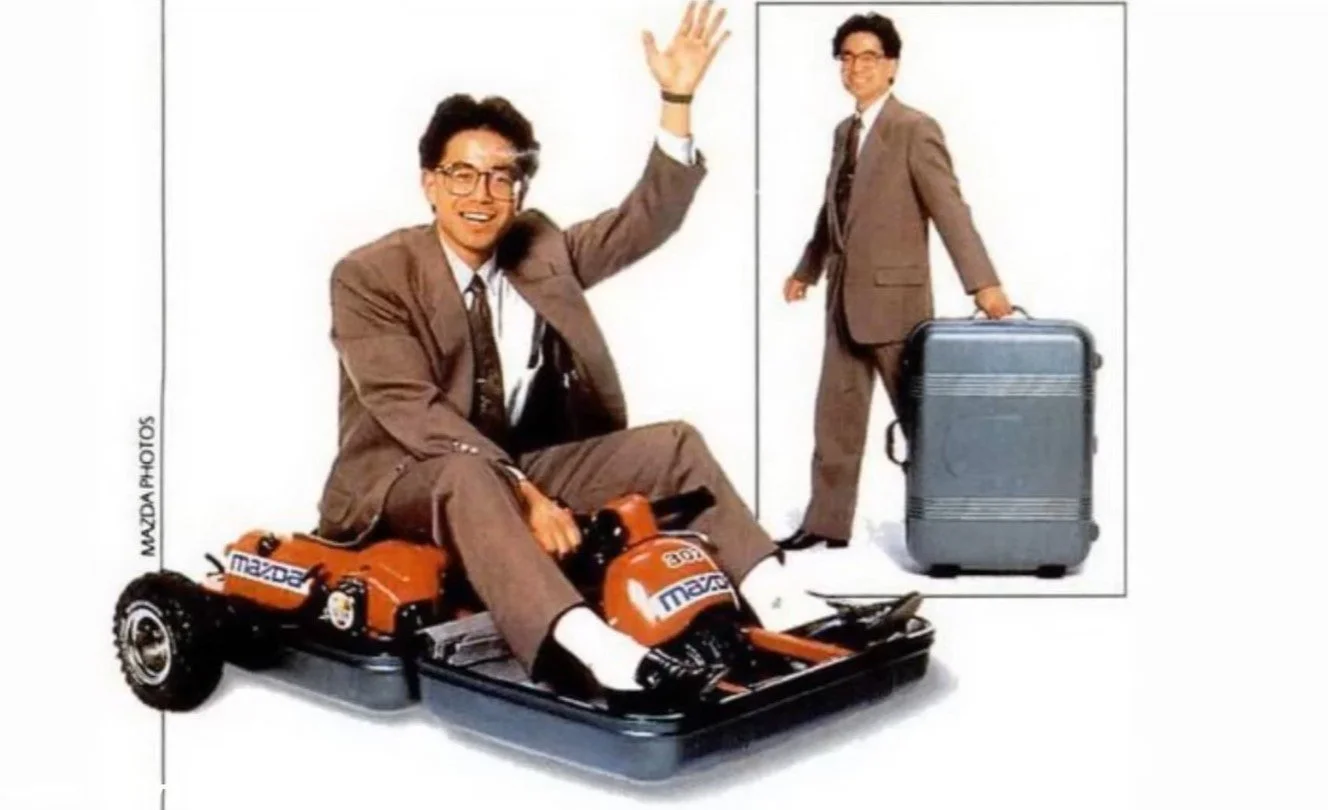
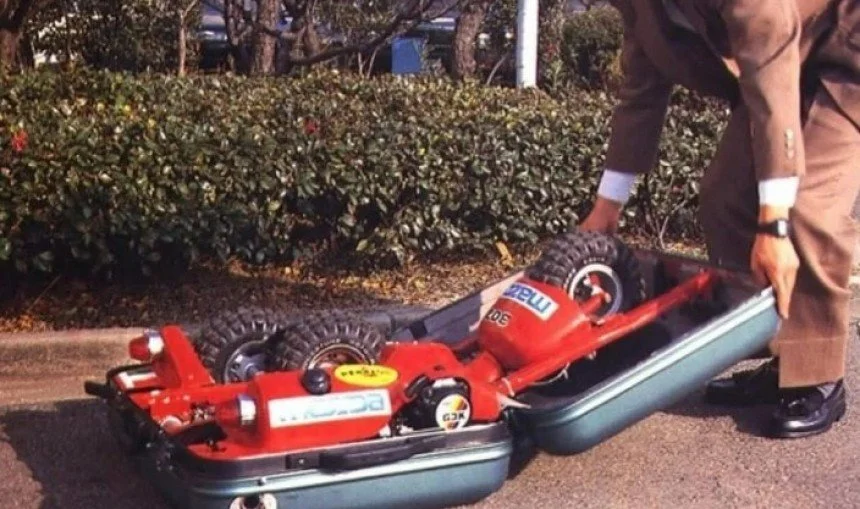
Let me say that again, a suitcase that unfolded into a car that could be driven. The idea was born from seven unnamed engineers in the manual transmission research and development department to get around the airport in more efficent manner. They submitted the idea and instead of Mazda having them committed they awarded them with a small budget to make their dream a reality. Again, what an incredible company that encourages its employees to create obscure and hilarious fun engineering products. Some might call this a waste of time and money, me, I see this as a form of allowing the employees to let loose. Once awarded the budget, half the team found the largest hard-shell suitcase they could muster while the other half a small three-wheel motorized bike.
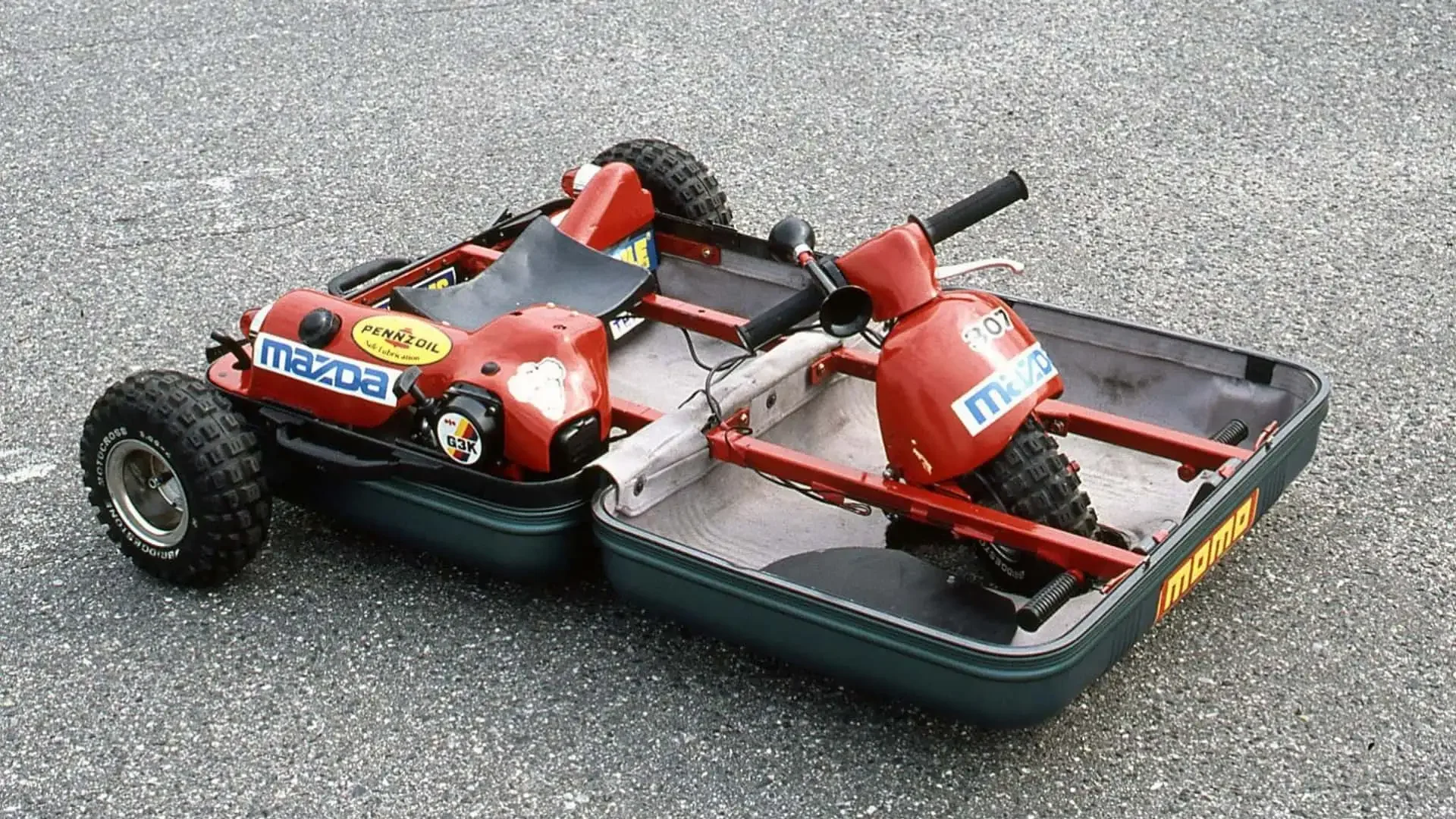
The light at the end of the tunnel was simple, clever, and delightfully bonkers. This pocket-bike housed a 34cm3 two-stroke engine that somehow gracefully fit like a glove (not OJ’s Isotoners) in a 57x75 cm hard shell Samsonite suitcase, after some basic modifications; reinforcement bars that ran parallel to each other on the inside for strength, a hide away hole was cut for the front wheel, but after that, assembly took barely a minute; a little swing of the front wheel upright through the removable panel, pop in the rear wheel on either side, clip the seat in above the rear axle, and voila you are now riding and controlling a motorized a 1.7 hp suitcase capable of getting you to your flight at an astonishing speed of 30 km/h (18 mph), only to have to wait in line because you are in group 8 in the boarding process.
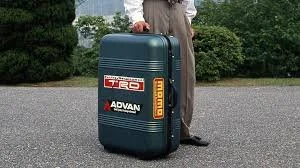
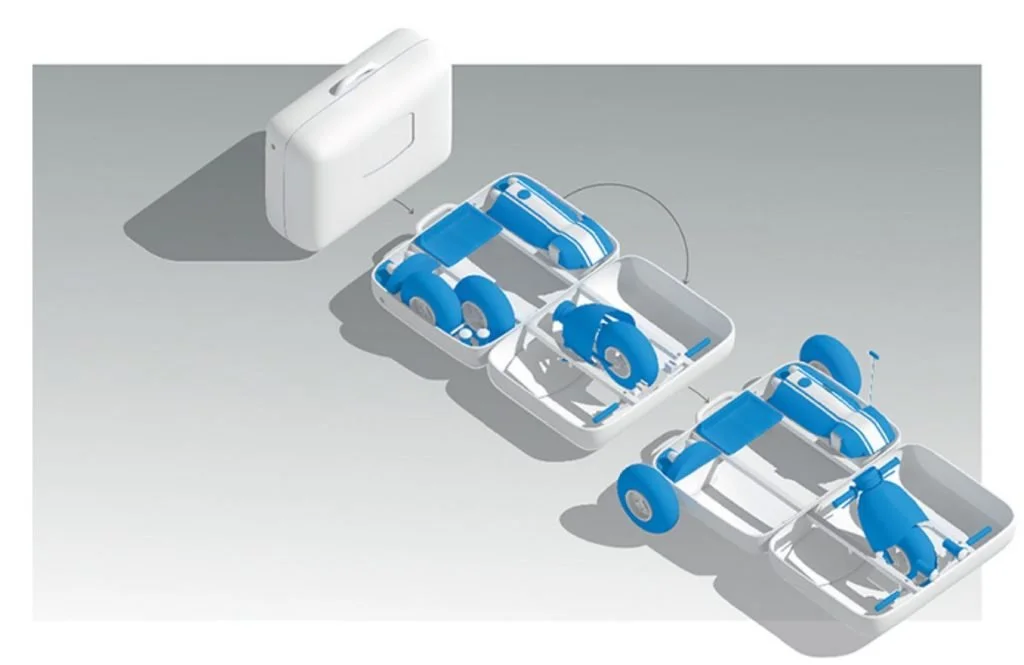
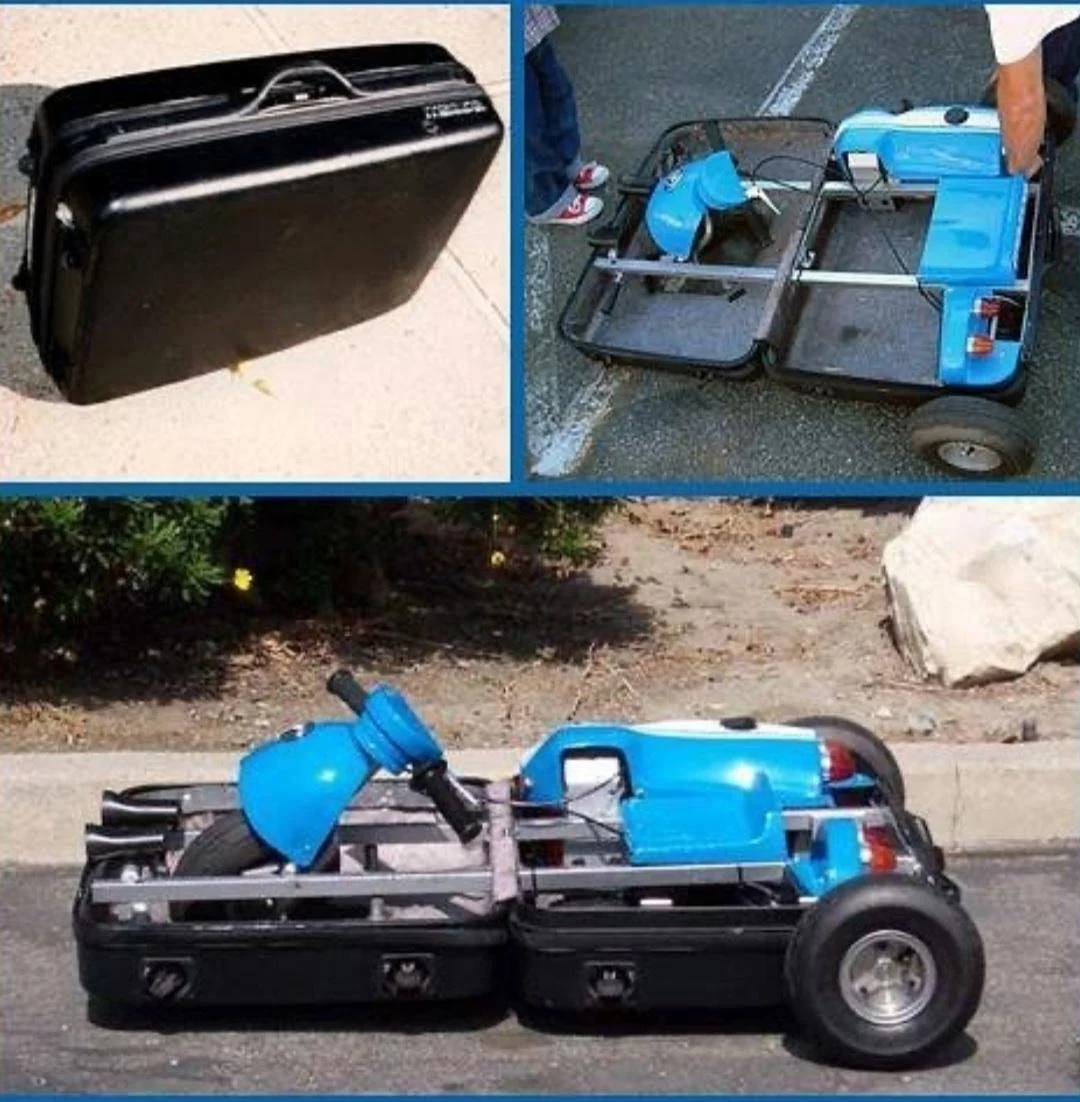
However, weighing in at hefty 32kg (70lbs) this incognito suitcase was hardly airline friendly, it would have to be checked-in which would defeat the whole purpose of the bag, not to mention the gas that it ran on would not be allowed. But mass production was never the point of this experiment, it was for engineers to let loose and have fun in harmless competition. Nevertheless, there is always an angle to be had, this so-called “convienent” and “portable” suitcase car became a media magnet or went “viral” as it would be said now, earning Mazda a wave of attention as a publicity stunt. The buzz was strong enough that not one but two additional versions were built, one for the European shores and one of the US. The European example shared the spotlight in 1991, sitting alongside the Le Mans–winning Mazda 787B Renown. And much like the tale of David and Goliath, it was the suitcase car—not the championship race car—that captured the crowd’s attention. This time, though, it was driven by curiosity and sheer whimsical fun. Today, only the U.S. version survives; the original was destroyed in an accident, and the European example vanished without a trace.
It was never said, but I do believe the inception or the at least the core design behind this car suitcase was inspired by Mazda’s very first vehicle, a vehicle that helped revolutionize delivery transportation and logistics in Japan which showcased Mazda inventive spirit, the Mazda-Go Type DA. Much like the car-suitcase it was a three wheel vehicle, a modern version of the rickshaw. It marked Mazda’s entry into automobiles, following their earlier motorcycle production. Without going down too much of a rabbit hole, the Mazda-Go entered production in 1931 and kept going after December of 1945. It was eventually replaced by an upgraded version called the K360 which went on sale in 1959.
Regardless of the reasoning, this small absurd creation gifted to the world by a team of seven engineers showed us the spirit, ingenuity, and ethos of Mazda. A company brave enough to defy convention and have fun along the way still runs through is vehicles today.

Regardless of the reasoning, this small absurd creation gifted to the world by a team of seven engineers showed us the spirit, ingenuity, and ethos of Mazda. A company brave enough to defy convention and have fun along the way still runs through is vehicles today.
